
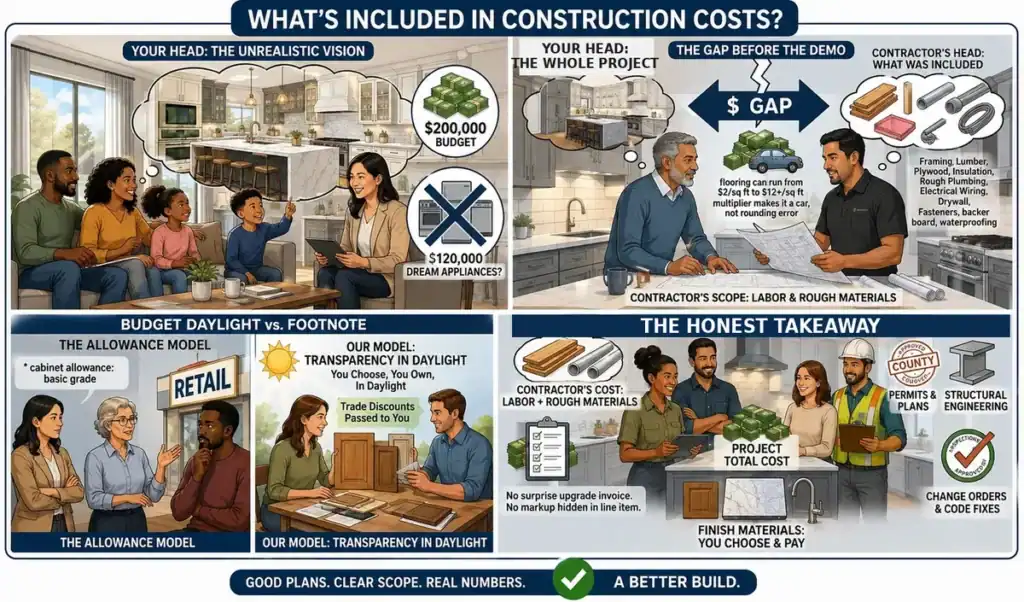
A homeowner in Danville once sat across from me with a $200,000 budget and a very clear picture in his head. Big kitchen. Oversized island. The works.
About twenty minutes in, he mentioned the appliance package he’d been dreaming about. A very high-end brand, top to bottom. All in, roughly $120,000. For one kitchen’s appliances.
We hadn’t drawn a cabinet yet. We hadn’t talked about demolition, moving plumbing, electrical, drywall, paint, or flooring. More than half his budget was already gone.
He wasn’t being unrealistic on purpose. He believed what most people believe: that the number a contractor gives you is what the whole project costs. It isn’t. And the gap between those two ideas is where almost every remodeling nightmare in the East Bay begins.
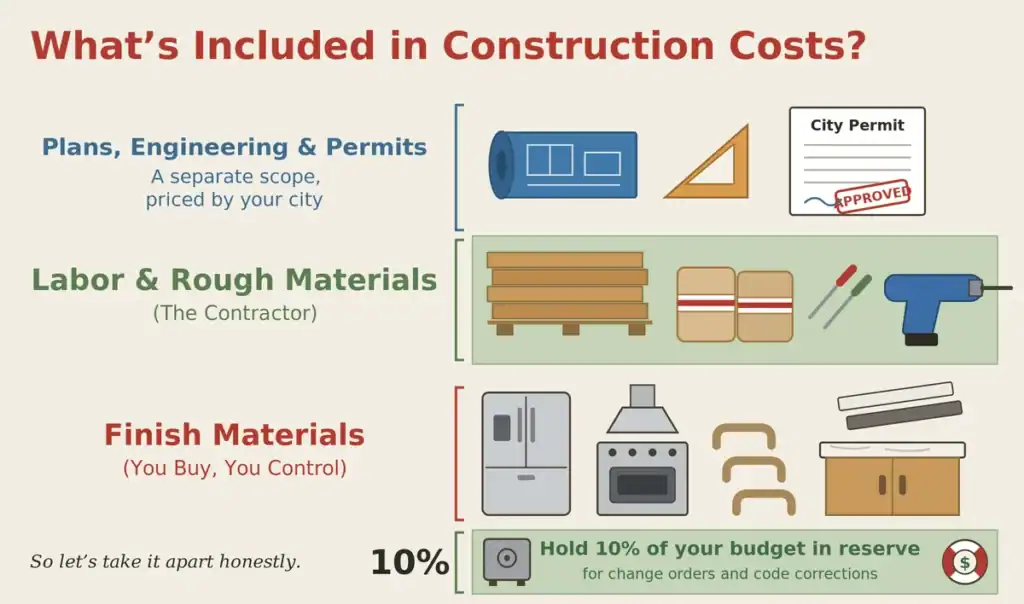
So let’s take it apart honestly: what’s included in construction costs, and what isn’t.
What does a contractor’s price actually cover?
At Taragano Design and Build, our contract covers labor and rough materials. That’s it, and we say so plainly.
Rough materials are what disappears behind your walls and under your floors: framing lumber, plywood, fasteners, drywall, backer board, insulation, wire, pipe, mortar, waterproofing, hardware, and a long list of other things you’ll never see. The unglamorous bones of the project.
Labor is everything my crews do: demolition, framing, rough plumbing and electrical, insulation, drywall, tile setting, cabinet installation, trim carpentry, paint, finish work, and everything in between.
What our contract does not automatically include are the finish materials, the items you’ll actually see, touch, and shop for. A few of the big ones: windows and doors, cabinets and vanities, countertops, appliances, flooring, tile and stone, plumbing and lighting fixtures, and roofing if the project calls for it. That list is a starting point, not a complete one. But those are the big-ticket items, and they’re the ones you control.
Permits, plans, and structural engineering sit in their own category. We offer them as a service, and most clients take us up on it, since it’s easier when one team carries the plans through the city. What they cost depends entirely on scope. A like-for-like bathroom may need nothing more than a designer’s sketch over the counter; the moment you touch structure or foundation, as an addition or an ADU always will, you’re into engineering, stamped plans, and a real plan check. I’ve broken down what a home addition really costs in a separate guide, including the soft costs that sit outside the construction number. Either way, it’s a separate scope with a separate cost, and it should be written that way.
Why don’t you just include finish materials in the price?
Because of a word that has caused more arguments in this industry than any other: allowance.
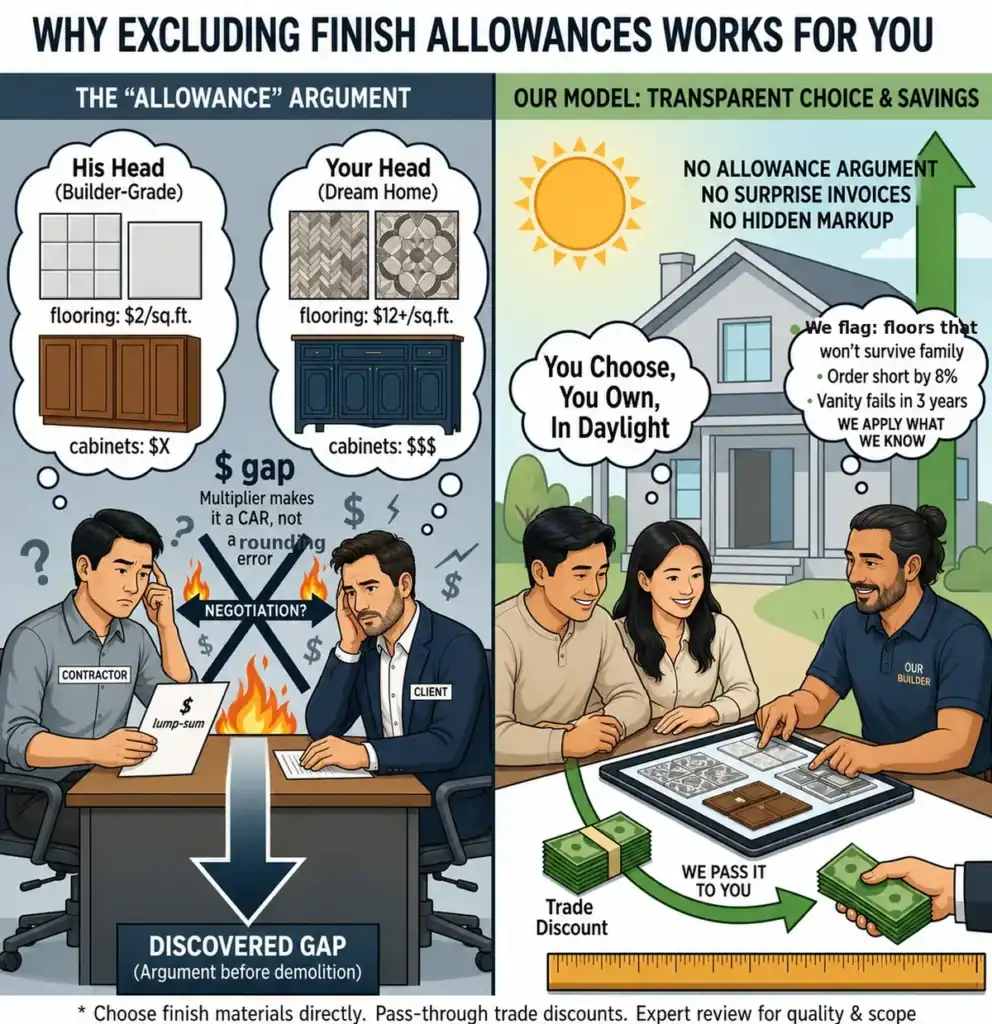
A contractor writes you one lump-sum number and buries a “cabinet allowance” and a “flooring allowance” inside it. In his head, those are builder-grade. In your head, you’re picturing the kitchen you’ve been saving photos of for two years. Nobody is lying. But flooring alone runs from about $2 a square foot to $12 or more. Multiply that gap by your square footage and it’s not a rounding error, it’s a car.
Here’s the part people don’t anticipate: you discover the gap before the job even starts. Contract signed, demolition not begun, and you’re already negotiating. Will he credit you if you buy your own? At what number: what he budgeted, or what he actually would have paid? Do you owe more because you chose something nicer?
Step back and look at that conversation. You’ve committed to spending months with this person in your home, and your first real exchange is an argument about money. That’s not how you start a relationship.
There’s a second issue nobody talks about. For many contractors that allowance line is a profit center: you’re shown retail while he buys at a trade discount and keeps the difference.
So we removed it entirely. You choose your finished materials, you buy them, you place the order. You own that part of the budget in daylight instead of finding it in a footnote. And where we have a trade discount that applies, we pass it to you rather than pocketing the spread.
We’re not shopping alongside you. You make your selections, share the list with us, and we apply what we know, flagging a floor that won’t survive your family, a vanity that fails in three years, an order that’s short by 8% and about to cost you two weeks.
No allowance argument. No surprise upgrade invoice. No markup hidden in a line item.
All of this belongs in the contract itself, in plain language. I’ve written a separate guide on what should be in a contractor agreement if you want the full checklist before you sign anything.
What’s in the price that homeowners never think about?
A bid also carries costs that have nothing to do with anything you can point at: dumpsters and debris hauling, portable toilet, daily cleanup, site protection, material take-offs, inspection scheduling, supervision, meetings, driving, gas, tolls, parking, and office time.
Insurance is its own category. General liability and workers’ compensation are annual company costs, not per-project ones. The premium is the same whether we run one job this year or twenty. Every legitimate contractor carries it, and every legitimate bid reflects it. You can verify any contractor’s license, bond, and workers’ comp status yourself through the California Contractors State License Board, and you should.
And 2026 has been rough on materials. Tariffs pushed up the boring stuff: lumber, steel, fasteners, copper. The Associated General Contractors of America reports construction input costs rose 7.1% between July 2025 and July 2026, with steel mill products up 22.5% and copper and brass up 18.4%. None of it shows up in a glossy remodeling photo. All of it shows up in a bid.
What about the things nobody can see yet?
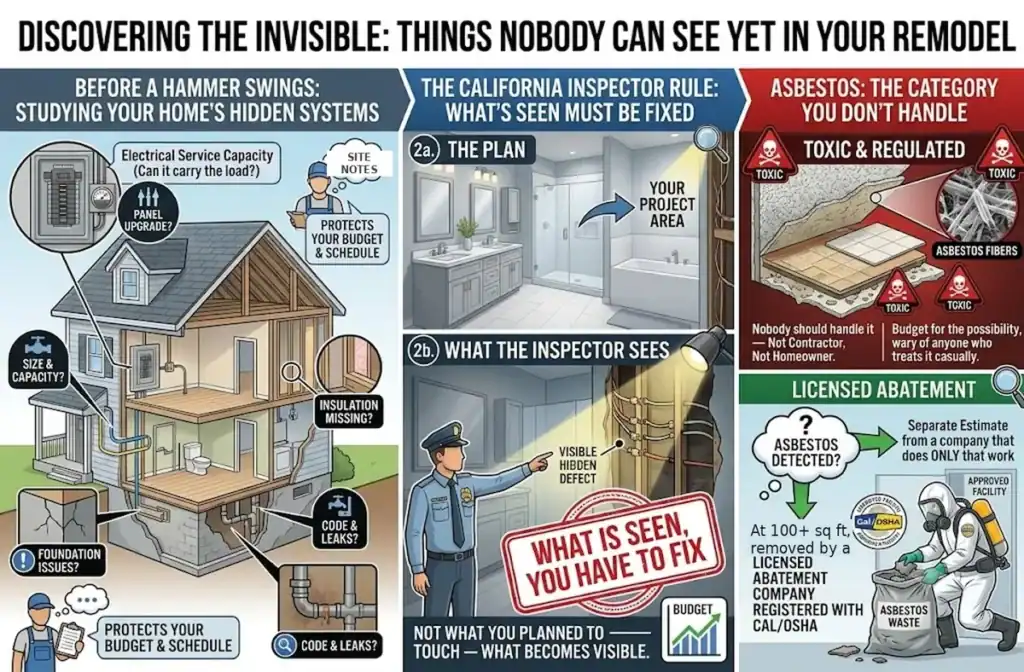
I wish I could tell you we understand everything before we start. We don’t. Nobody does. What we can do is discover as much as possible before a hammer swings, and that’s exactly what protects your budget and your schedule.
So before we ever talk about cabinets, we study the home: whether the electrical service can carry what you’re adding, whether the water and gas lines are sized for it, whether there’s insulation where there should be, what shape the foundation is in, whether the plumbing meets today’s code. None of that is glamorous. All of it is expensive to discover late.
And there’s a California rule homeowners find hard to accept: what the inspector sees, you have to fix. Not just what you planned to touch, but what becomes visible.
Asbestos is its own category. California law requires that removal of 100 square feet or more of asbestos-containing material be done by a licensed abatement contractor registered with Cal/OSHA and disposed of at approved facilities. Our policy is stricter than the law: we don’t touch it at any quantity, and neither should you. It’s toxic, tightly regulated, and it belongs to specialists who do only that work. If it turns up, you’ll get a separate estimate from an abatement company. Budget for the possibility, and be wary of anyone who treats it casually.
How much should you hold back for surprises?
Ten percent. Set it aside and pretend it doesn’t exist.
Worth understanding: on our projects, most change orders don’t originate with us. We investigate enough up front that we’re rarely the ones bringing you bad news.
Most come from you, and that’s normal. The crew is already there. The contract is in place. The walls are open. And somewhere in week three you think: while everyone’s here, why not do the hallway too? Why not upgrade the appliances? Those aren’t mistakes; they’re what happens when you watch your home change in front of you. But each one is a change order, and change orders cost money and time.
The other source is the inspector. During rough inspections, with everything open and visible, he may find that portions of the area we’re remodeling aren’t up to current code. In California that isn’t negotiable. It gets corrected.
Ten percent absorbs both. Zero percent turns either into a crisis.
Why isn’t the lowest bid the cheapest project?
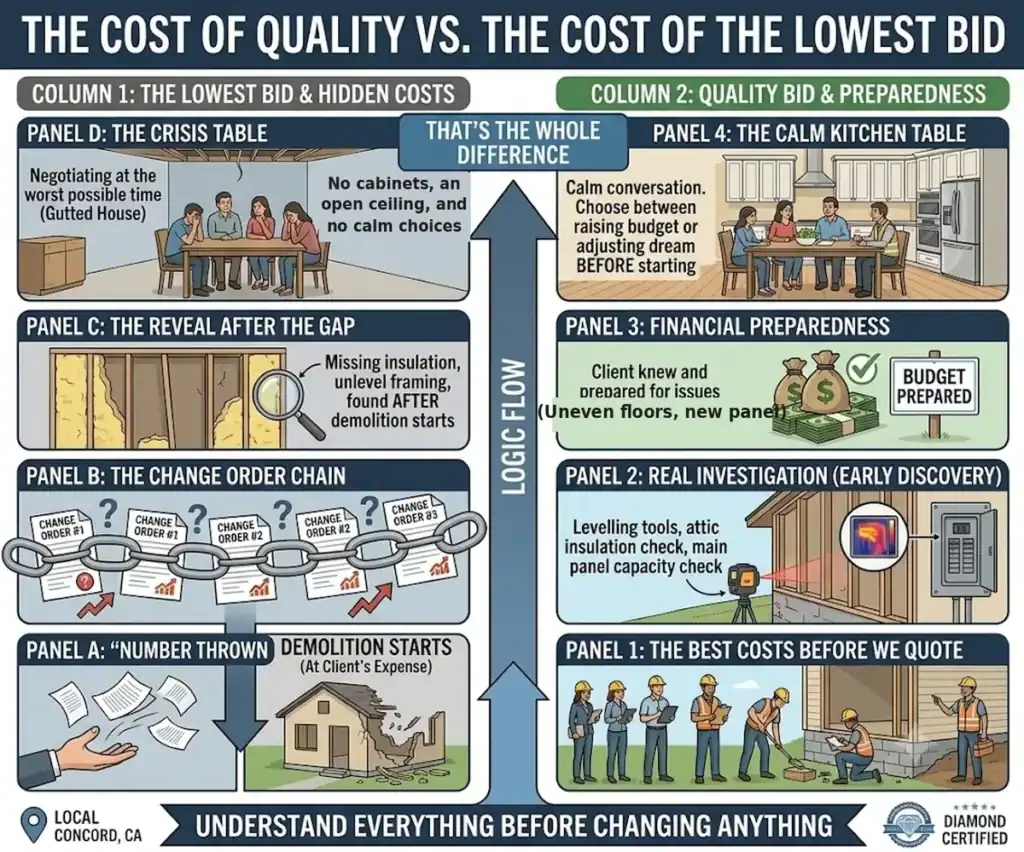
We don’t try to be the cheapest. We try to be the best, and those are different businesses.
Being the best costs something before we ever quote you. Real investigation into your house, in your city, with its own age and code history. More than one meeting. We’re not competing on a number. We’re competing on quality.
The contractor who wins with a number thrown in the air hasn’t done that work yet. He’ll do it after demolition starts, at your expense, one change order at a time. That’s not bad luck. That’s the business model.
My Danville client with the $120,000 appliance package found out at the kitchen table, not in a gutted house. It was an uncomfortable conversation, but he could still choose calmly between raising the budget and adjusting the dream. Nobody makes that choice calmly with no cabinets and an open ceiling.
Compare it to another Danville project, an addition on a house whose floors told us something before anyone spoke. Uneven and out of level, which meant framing and foundation work first. No insulation in the attic. And a main panel without the capacity for the addition plus the EV charger the family wanted.
None of it appeared on the plans they brought us. But we found it early, told them early, and they were financially prepared before we started. That project ran smoothly, not because nothing went wrong, but because nothing was a surprise.
That’s the whole difference. Understand everything before changing anything.
Frequently Asked Questions
Does a contractor’s bid include appliances and cabinets?
Not in our contracts, and you should confirm it in writing with anyone you hire. We contract for labor and rough materials. Finished materials (cabinets, appliances, windows, doors, flooring, tile, countertops, and fixtures) are purchased by the homeowner, with our guidance on quality, quantity, sourcing, and timing, plus any trade discounts we can pass along.
What is a construction allowance, and should I accept one?
An allowance is a placeholder dollar amount a contractor inserts for a material you haven’t selected yet. The risk is that his placeholder assumes builder-grade and your expectations assume something much nicer. If a bid you’re reviewing uses allowances, ask for the exact product, model, and grade each one assumes. If the answer is vague, treat the total as incomplete.
How much should I budget for unexpected costs on an East Bay remodel?
Ten percent of your total project budget, held in reserve. Most of what that covers comes from two places: changes you decide on once work is underway, and code corrections the inspector requires during rough inspection. A genuine surprise, something nobody could have seen behind a wall or under a floor, does happen in older homes, but thorough investigation up front keeps it rare.
Are permit fees the same across Contra Costa County?
No. Fees vary by jurisdiction, and some properties fall under city authority while neighboring ones fall under unincorporated county authority. Fees are also valuation-based, so a bathroom remodel, a kitchen, an addition, a garage conversion, and an ADU carry very different costs and timelines. Always get a jurisdiction-specific estimate before you finalize a budget.
The Bottom Line on What’s Included in Construction Costs
A construction bid isn’t a price tag on a finished house. It’s a price on labor, rough materials, insurance, supervision, and risk. The rest of your budget belongs to the choices only you can make.
The contractors who blur that line aren’t saving you money. They’re deferring the conversation until you have no room left to negotiate.
Ask what’s in the number. Ask what’s not in the number. Ask what happens when the wall comes open. A builder who welcomes those three questions is a builder worth hiring.
An accurate estimate isn’t the one that makes you happy today. It’s the one that still makes sense in month four.
Ready to talk about your project?
If you’re planning a kitchen, bathroom, addition, ADU, or whole-home remodel anywhere in the East Bay, I’d be glad to walk your home with you and give you an honest picture of what it will actually take. We offer a complimentary consultation: a real conversation about your house, not a number thrown in the air.
Call or text (925) 388-6353, or visit taraganobuild.com.
We serve Walnut Creek, Lafayette, Orinda, Moraga, Danville, Alamo, Pleasant Hill, Concord, San Ramon, and the surrounding East Bay. Want more of our remodeling guides in your Google results? Add us as a preferred source.
Yaniv Taragano is the owner of Taragano Design and Build, a Diamond Certified design-build firm serving Contra Costa County and the East Bay for more than twelve years. CSLB License #1143420, licensed, insured, and bonded. Rated 5.0 stars on Google and Houzz, ranked in the top 2% of California contractors on BuildZoom, and BBB accredited.
