
By Yaniv Taragano, Founder, Taragano Design and Build
Last verified against City of Concord program information on September 7, 2026.
If you are thinking about building an accessory dwelling unit in Concord, there is a financial incentive worth looking at right now. The City of Concord is offering ADU rebates of up to $15,000. The program is limited, and the application deadline is approaching.
The City says applications must be submitted before September 30, 2026, and that rebates are reserved on a first-come, first-served basis while funds last. That second part matters more than the date. September 30 is the application deadline. It is not a guarantee that money will still be available when you get there.
I want to be straightforward about why I wrote this. Most of what is published about this rebate repeats the $15,000 headline and stops. There are details in the City’s own program terms that decide whether a homeowner actually receives the money, and they are not in the headline. So this article goes through the program as the City has written it, and then explains what I would look at on your property before I would let a rebate influence a construction decision.
How Much Is the Concord ADU Rebate?
The rebate amount depends on the size of the ADU and on whether the unit will carry a 20-year low-income deed restriction.
Low-income restricted ADUs:
- 500 square feet and less: $15,000
- 501 to 750 square feet: $10,000
- 750 to 1,000 square feet: $5,000
Non-restricted ADUs:
- 500 square feet and less: $7,500
- 501 to 750 square feet: $5,000
- 750 to 1,000 square feet: $2,500
The City’s published table lists no rebate for units over 1,000 square feet.
One note on precision, because it matters if your design is near a line. The City’s table shows the second band as 501 to 750 and the third as 750 to 1,000, so a unit at exactly 750 square feet appears in both. Confirm the amount with the City rather than assuming.
The larger point is that $15,000 is not the standard rebate for every Concord ADU. It is the top of the low-income restricted category for the smallest units. For a non-restricted ADU under 500 square feet, the maximum is $7,500.
The $15,000 Tier Is Less Restrictive Than Most People Assume
This is the part of the program I see misread most often, and it is worth slowing down on.
First, the rebate itself is not income dependent. The City states this directly. Your household income has nothing to do with whether you qualify. The words “low-income” refer to a restriction on who may eventually rent the ADU, not to the person applying.
Second, and this is the detail that changes the decision for a lot of homeowners: the City says the ADU does not have to be rented at all. Under the deed restriction, the unit may sit vacant, or family or friends may live in it rent-free regardless of their income. The restrictions apply once you charge rent.
So if you are building a small ADU for a parent, an adult child, or a guest suite you do not intend to rent commercially, the low-income restricted tier may be worth $15,000 instead of $7,500 at very little practical cost to you. That is a meaningful difference, and almost nobody writing about this program explains it.
If you do intend to rent it, the terms matter. According to the City:
- The deed restriction applies to the ADU for 20 years
- Tenants must qualify as low-income, defined as a maximum of 80% of median income, and current rates should be confirmed with your project planner
- Maximum rent is 35% of the renter’s gross income
- The restriction must be recorded on the property title before construction of the ADU is complete
That last requirement is easy to get wrong. It is not something handled at the end when a check is issued. In the City’s process, the deed restriction is recorded before the ADU is finished.
The City also notes that LLCs are only eligible for rebates on low-income restricted ADUs, and that rebates are not available for mobile homes or RVs, because the ADU must be on a permanent foundation. The City further recommends consulting a tax professional before accepting a rebate to understand how it affects your situation. I would take that seriously rather than treat it as boilerplate.
Is the Concord ADU Rebate Still Available?
According to the City’s current program page, the rebate program is accepting applications through September 30, 2026, subject to available funds.
The City describes the Concord ADU rebate as first-come, first-served. If your application is approved, the rebate amount is reserved for you, but nothing is paid at that point. The rebate is paid after the ADU is complete and the building permit is finaled.
Applications go to ADURebate@cityofconcord.org, and the City says you will receive an email notification of approval or denial. That is also the address to use if you want to ask about current funding status before you plan around the program. I would send that email before doing anything else.
Who Can Apply?
The City’s rebate program is for property owners who will be applying for an ADU building permit, or who already have an application in “Applied” or “Approved” status.
One point worth confirming. The City’s rebate program page refers to ADUs generally, while its financial assistance page refers specifically to detached ADUs. If you are planning a garage conversion or an attached unit, ask the City about eligibility before you count on the rebate.
The rebate is not available for a building permit that has already been issued, and it does not apply to an unpermitted ADU. The City allows only one rebate per single-family residential lot, and limits rebates to one per individual or entity, including trusts.
If you have already pulled your permit, you have missed this program. I would rather tell you that early than have you spend a week on an application that cannot be approved.
The Deadlines That Actually Cause Problems
Most coverage of this program stops at September 30. The deadlines that come after the application are the ones that put a rebate at risk.
According to the City’s current requirements, your ADU building permit must be issued within six months of your rebate application date, and construction must be complete with the building permit finaled within 18 months of the permit being issued. Extensions may be granted for good cause as determined by the City.
Here is the part I want homeowners to notice. The City puts the burden of notification on the applicant. You are responsible for emailing the City when your permit is issued, and again when your permit is finaled. If you do not, the City’s terms say the rebate can be forfeited.
Nobody is going to track your project for you. This is the likeliest way a homeowner who qualified for the Concord ADU rebate ends up not receiving it. Not a denial, and not a rule they failed to meet, but a missed email eighteen months into a project that nobody was managing against the rebate calendar.
That is also why I treat these dates the same way I treat any other contractual milestone. A rebate with a forfeiture clause is a schedule obligation, and it belongs in the project plan alongside everything else you and your contractor agree to in writing. If you have not thought about how obligations like this get documented, what should be in a contractor agreement covers the ground.
Six Months Is Tighter Than It Sounds
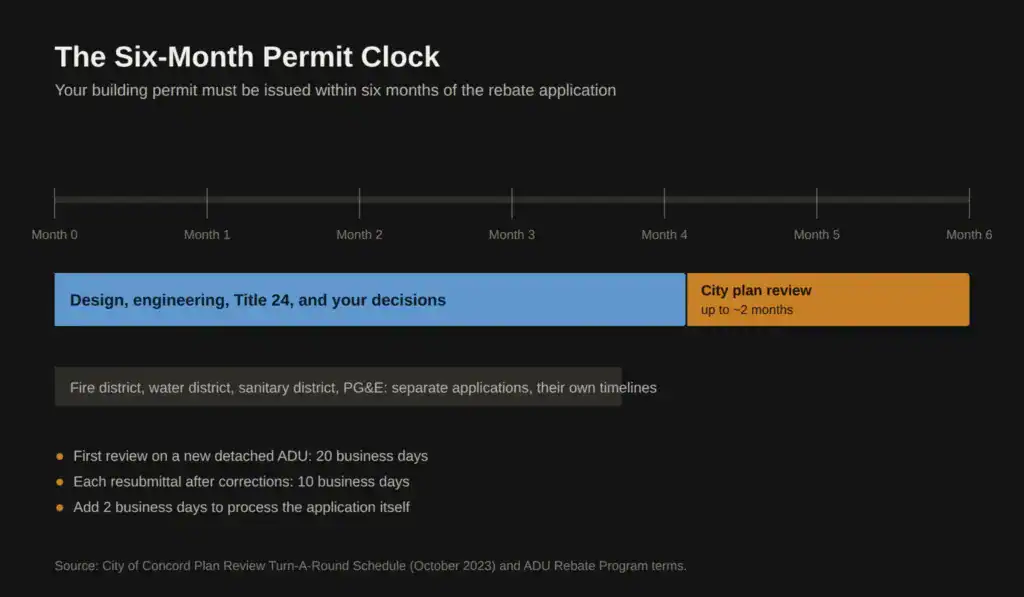
The deadline homeowners underestimate is not September 30. It is the six months between your rebate application and permit issuance.
You do not have to guess at how much of that window the City consumes, because Concord publishes its plan review turnaround schedule. The figures below come from that document, which is dated October 2023, so treat them as the City’s stated targets rather than a promise about your project.
For a new detached ADU, which the City reviews under the “New” residential category, the published target is 20 business days for the first review and 10 business days for each subsequent review. A conversion or an attached unit falls under alteration or addition, at 10 or 15 business days for first review and 5 for subsequent. Add two business days on top for processing the application itself.
Run the arithmetic on a custom detached ADU. Twenty business days is about a month. If plan check returns corrections once, which is common enough that the City publishes a turnaround time for resubmittals, add another two weeks. Two correction cycles and you are near two months of City review alone, before anyone has drawn anything, and before construction starts.
Then there is the part almost nobody accounts for. The City’s schedule notes that outside agencies including the fire district, the water district, the sanitary district, and PG&E require separate applications on their own timelines, which the City does not control and which can run longer than its own. The City’s own guidance is to apply to those agencies at the same time as, or before, applying for the building permit. A homeowner who does not know that finds out about it six weeks in.
So the work itself is rarely what costs you the time. The handoffs are. A designer waits on the engineer, the engineer waits on a survey, nobody filed with the sanitary district in week one, plan check comes back and no one is contractually responsible for turning corrections around this week rather than next. Add three of those gaps to two months of review and six months is gone, along with a rebate that was already reserved in your name.
For an additional fee, the City does offer expedited review, which it says typically reduces the Building division’s review time by five business days. It does not shorten the other divisions’ reviews, so it helps at the margin rather than solving the schedule.
This is the practical argument for hiring a design-build firm rather than assembling the team yourself, and it is not really an argument about quality. It is an argument about who owns the calendar. When design, architecture, structural engineering, permitting, and construction sit under one contract, there is one party accountable for the permit date, and correction responses do not wait on somebody else’s schedule.
I want to be exact about what that does and does not include. The rebate application is yours. The City’s program is written for property owners, it allows one rebate per individual or entity, and the check is issued to the property owner. We do not submit it for you, and I would be cautious with any contractor who offers to. What we take care of is everything between the decision and the finaled permit. What we take care of is everything between the decision and the finaled permit: the property evaluation, the design, the engineering, the plan set, the permit submittal and corrections, the construction, and the final inspection. You send two emails to the City, one when the permit issues and one when it finals, and we tell you when to send them.
That division is worth understanding before you hire anyone, because it tells you what you are actually buying.
Concord’s Free Pre-Approved ADU Plans
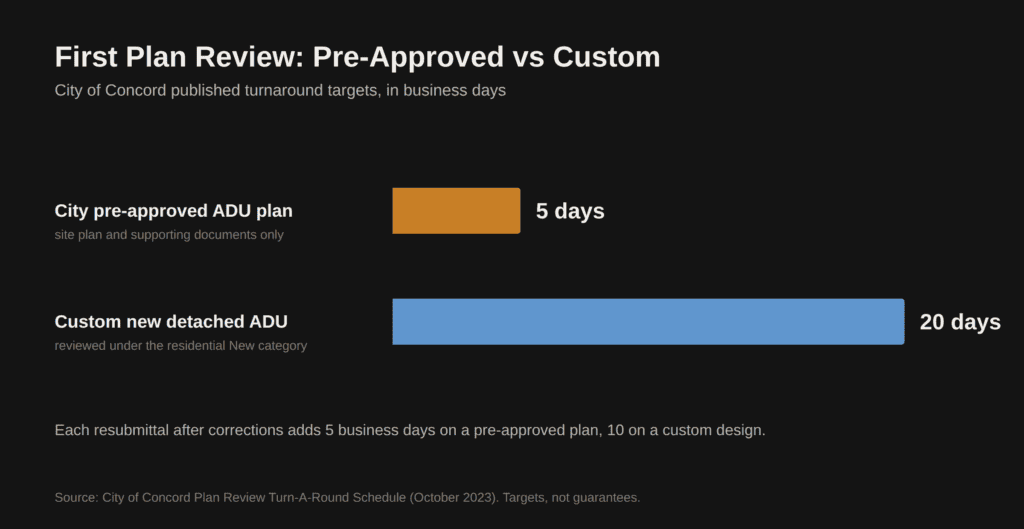
The rebate is not the only reason Concord is an interesting place to build an ADU.
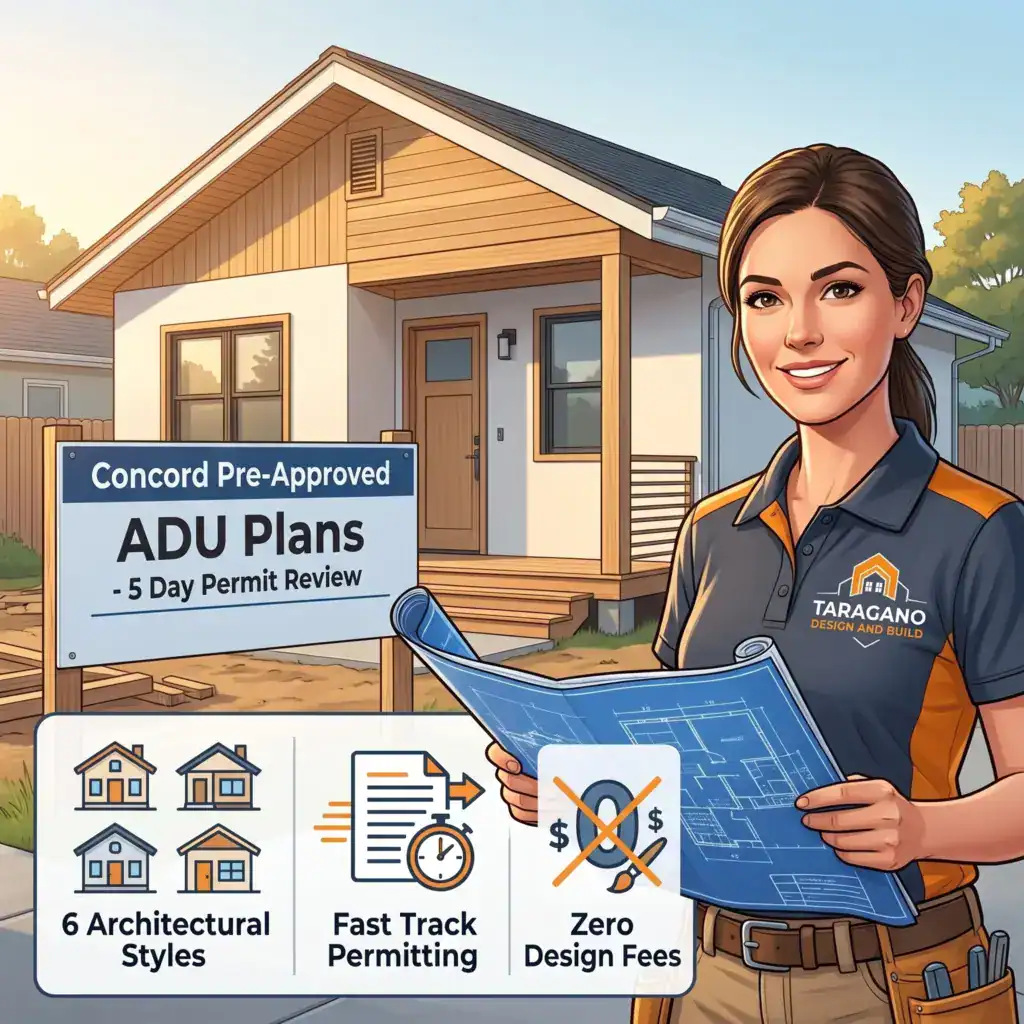
The City also offers free, pre-approved ADU construction plans. There are currently six plan types, ranging from approximately 205 to 874 square feet, and they include studio, one-bedroom, and two-bedroom layouts in several architectural styles.
For a property and a program that fit one of these plans, this can reduce design costs and simplify permitting. The City says that when the site-specific plan and required documents are accurate and complete, permits for these designs may be issued within five working days. For context, the City says a complete application for a standard permit is typically issued within 60 calendar days.
Read that condition carefully, because it is doing a lot of work. The five working days depend on the site-specific plan and the required documents being accurate and complete.
The City’s published plan review schedule confirms how large that gap is. An ADU using the City’s pre-approved plans is reviewed in five business days, and the City’s own footnote explains that this covers the review of the site plan and supporting documents only. Every other ADU application follows the schedule for the project type it aligns with, which for a new detached unit is 20 business days for first review. That is the difference between one week and roughly a month, decided entirely by whether you use a pre-approved plan and whether your submittal is complete.
The expedited path is available to everyone and earned by the quality of the site plan package, which is why the same free plan produces a permit in a week for one homeowner and considerably longer for another.
The limits are more reasonable than they first appear. The City says the pre-approved design must be permitted as designed, but the ADU may be oriented in any direction and the floor plan may be mirrored, and neither counts as a revision. If you want to change the design, layout, or floor plan, that requires a separate permit application. You can file it at the same time as the pre-approved permit, but it does not receive the same expedited review, and the City notes that not all proposed changes will be approved.
A free plan is a real advantage when it fits the property. It is not automatically the right plan for every property, and the expedited timeline is only an advantage if you are willing to build the plan as drawn.
What Concord’s Rules Allow on Your Property

Concord’s requirements differ depending on whether the ADU is attached, detached, converted from existing space, or built as a new addition. A few of the standards that most often shape a project:
- For a new detached ADU and for a new addition, the City lists a 4-foot interior side and rear setback. Front and exterior corner side setbacks of the zoning district still apply, unless the ADU is 800 square feet or less and cannot feasibly be built elsewhere on the lot.
- A detached ADU may measure up to 16 feet tall, with 18 feet allowed in specific circumstances such as matching the main dwelling’s roof pitch, or being within a half mile of a BART station or Clayton Road. Attached ADUs may reach 25 feet if they do not exceed two stories.
- Concord exempts certain ADUs from many local development standards. A detached ADU qualifies if it is 800 square feet or less, complies with the height limits, and is set back at least 4 feet from the side and rear property lines. Exempt ADUs are also exempt from the City’s design standards. The 800 square foot figure is a zoning exemption threshold and is unrelated to the rebate size bands above.
- Parking is generally one off-street space, with exemptions that include garage conversions and ADUs within a half mile walking distance of transit.
- ADUs and junior ADUs (JADUs) cannot be rented for fewer than 30 consecutive days.
Converting existing space usually carries no additional setback requirement, though the distance still has to satisfy fire and safety requirements.
None of this replaces a conversation with the City about your specific parcel. It should give you a sense of why two properties on the same street can support very different projects.
The Details Most Homeowners Do Not Expect
These come up repeatedly in our own ADU work and rarely appear in articles about rebates.
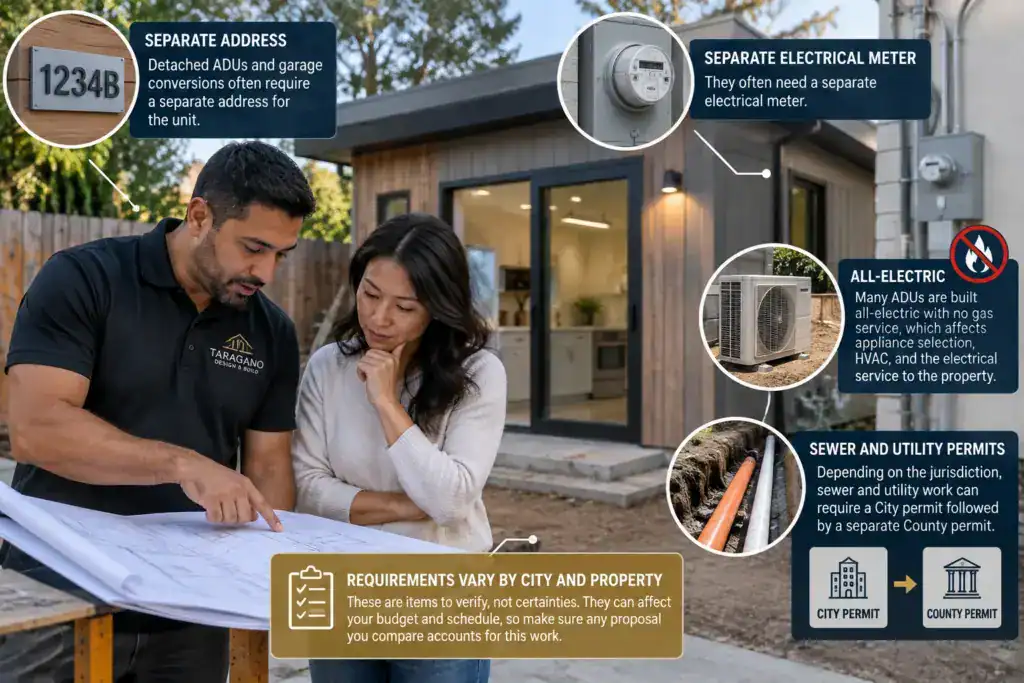
Detached ADUs and garage conversions often require a separate address for the unit. They often need a separate electrical meter. In many cases they are built all-electric with no gas service, which affects appliance selection, HVAC, and the electrical service to the property. And depending on the jurisdiction, sewer and utility work can require a City permit followed by a separate County permit.
These vary by city and by property, so treat them as items to verify rather than as certainties. I raise them early with clients for two reasons. They affect budget and schedule in ways that are difficult to absorb later, and a homeowner comparing two proposals deserves to know whether both of them accounted for this work.
What Does an ADU Cost in Concord?
The rebate is helpful. It should not set your budget.
Most articles on this subject will not give you a number. I will, with the understanding that these are starting points and not a quote for your property.
For ground-up ADU construction at the standard we build to, costs generally start around $450 per square foot and run to $650 or more, depending on scope, site conditions, and the level of finish. Design and engineering, meaning the complete permit set with architectural plans, structural engineering, and Title 24 documentation, generally runs $15,000 to $30,000 depending on the complexity of the property and whether the design is custom.
Now put those numbers next to the rebate.
A 500 square foot ADU, which is the size that earns the largest rebate in both categories, is a project somewhere in the range of $225,000 to $325,000 before unusual site conditions. The maximum rebate on that unit is $7,500 without a deed restriction, or $15,000 with one. That is roughly two to six percent of the project.
I am not saying that to talk you out of applying. Fifteen thousand dollars is real money and if you qualify you should go get it. I am saying it because a number at that scale should not be what decides whether you build, what size you build, or how fast you move. If the rebate is what makes the project work financially, the project does not work.
This is also where Concord’s free pre-approved plans stop being an abstraction. They remove the architectural design portion of that $15,000 to $30,000, though not the whole figure. You will still need a site-specific plan set, and depending on the property you may still need a survey, soils work, and utility and structural documentation. When a pre-approved plan genuinely fits, the savings are substantial and immediate. When it does not fit, forcing it onto the property usually costs more than it saves.
Beyond that, two homeowners can build the same square footage and end up with very different project costs. Site access, foundation conditions, utility connections, electrical service, sewer and water requirements, grading, existing landscaping, structural work, windows and doors, and finish selections all move the number.
This matters most when you are comparing proposals. A lower price does not mean the same scope of work, and the difference is usually in what one proposal left out. I have written separately about what is actually included in construction costs, because this is where most homeowners get surprised.
Before comparing prices, make sure you are comparing the same project.
How I Would Approach It
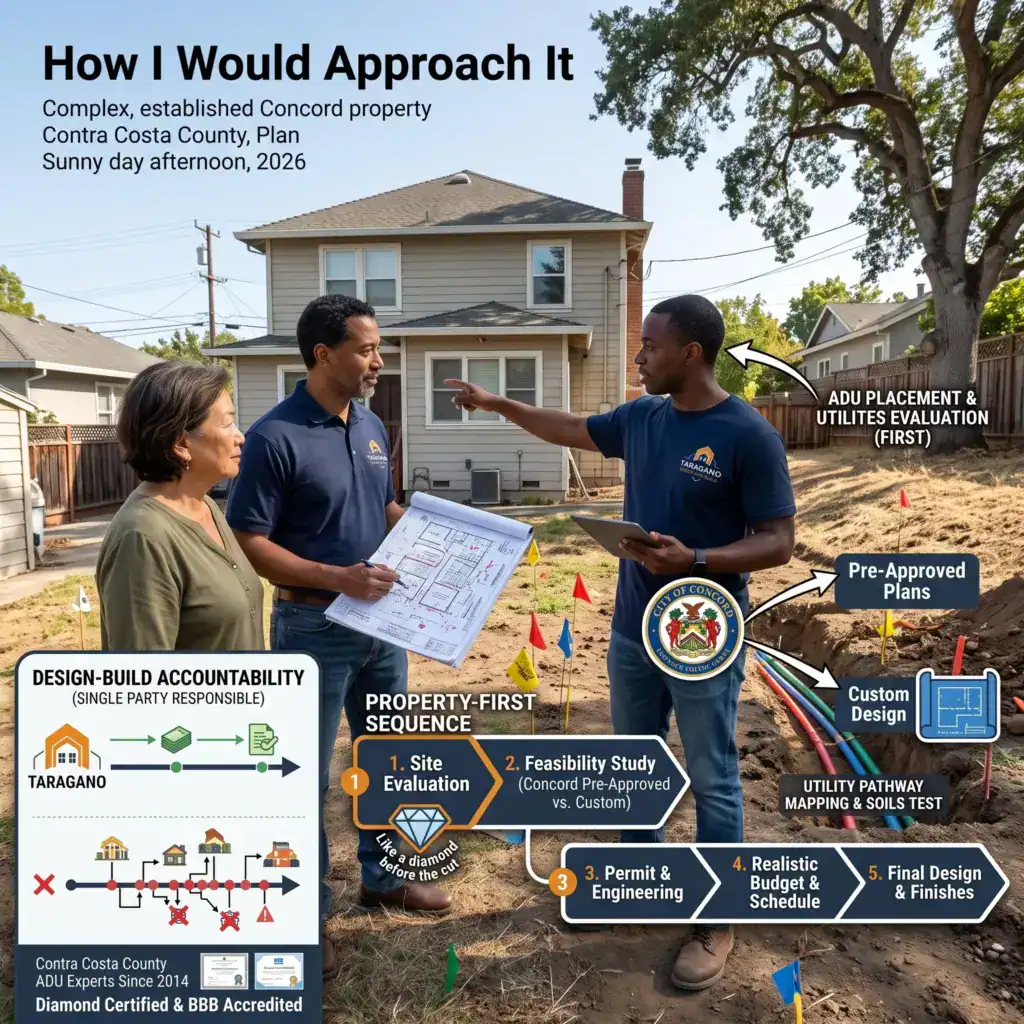
An ADU is not a product you order. It is a building that has to work on a particular piece of land, which is why I start with the property rather than the floor plan.
Before selecting a plan, I want to understand where the existing house sits, where an ADU could go, how utilities will reach it, how people will access it, and what site conditions will affect construction. My background before construction was in diamonds, where a stone is evaluated before anyone decides how to cut it, and I have never found a reason to work differently on a building.
From there the sequence is straightforward. Confirm what the property can support. Decide whether one of Concord’s pre-approved plans genuinely fits, because if it does, it is an efficient path, and if it does not, a custom design usually produces a better result. Establish the permit and engineering requirements. Build a realistic construction budget and schedule. Only then does it make sense to finalize finish selections and pricing.
This is the same sequence we run on a home addition or a whole house remodel, and for the same reason. A permit-driven project either has one party accountable for the approval date or it has a series of vendors who are each individually on time while the project as a whole is late. If you are weighing a single design-build contract against hiring the pieces separately, I made that case in detail in should I hire one contractor or multiple.
We have been building in Contra Costa County since 2014, we are Diamond Certified and BBB accredited, and you can see how we handle this work on our ADU design and construction page.
What I Would Do This Week
If you want to pursue the Concord ADU rebate, here is my recommendation, in this order.
1. Email the City first.
Send a note to ADURebate@cityofconcord.org and ask whether rebate funds are still available. The program is first-come, first-served while funds last, so this answer determines whether the rest is worth your time. Do not build a schedule around September 30 until you know the money is there.
2. Check your permit status.
If your ADU building permit has already been issued, you are not eligible, and you can stop here.
3. Find out what your property will actually support
before you choose a plan or a size. The size of the unit determines the rebate tier, so this decision and the rebate decision are the same decision.
4. Decide on the low-income restricted option deliberately.
If you are not going to charge rent, the restriction may cost you very little and be worth twice the rebate. If you are going to rent it, read the 20-year terms carefully and talk to a tax professional.
5. Get moving on the plan set immediately after you apply.
The six-month permit clock starts on your rebate application date, not on the day you decide to hire someone. If you apply in September and start looking for a designer in November, you have spent a third of the window before anyone has drawn anything.
You submit the rebate application. We handle everything after it: the property evaluation, design, structural engineering, permit submittal and corrections, construction, and final inspection, with the City’s deadlines built into the schedule from day one rather than remembered later.
Call us at (925) 388-6353 or request a consultation, and we will start with your property rather than a floor plan.
Frequently Asked Questions
Is the Concord ADU rebate really $15,000?
It can be, but not for every ADU. The $15,000 amount applies to a qualifying low-income restricted ADU of 500 square feet or less, and it requires a 20-year deed restriction on the property. The maximum for a non-restricted ADU of 500 square feet or less is $7,500.
Do I have to be low-income to qualify?
No. The City states that rebate reservations are not income dependent. The low-income designation restricts who may rent the ADU under a deed restriction, not who may apply for the rebate.
Do I have to rent the ADU out if I take the low-income restricted rebate?
According to the City, no. The unit can remain vacant, or family or friends can live in it rent-free at any income level. The income and rent restrictions apply once rent is charged.
What is the deadline for the Concord ADU rebate?
The City says applications must be submitted before September 30, 2026. Rebates are first-come, first-served while funds last.
Can I use the rebate if my building permit has already been issued?
No. The City’s rebate program requires an application that is forthcoming or in “Applied” or “Approved” status. Rebates are not available for permits already issued or for unpermitted ADUs.
How long do I have to finish the project?
Under the City’s current requirements, the building permit must be issued within six months of the rebate application date, and construction must be complete with the permit finaled within 18 months of permit issuance, unless the City grants an extension for good cause. The applicant is responsible for notifying the City at both milestones.
How long does it take to get an ADU permit in Concord?
The City publishes plan review targets in business days. An ADU using the City’s pre-approved plans is reviewed in five business days, covering the site plan and supporting documents. Other ADU applications follow the schedule for the matching project type, which is 20 business days for first review on a new detached unit, with 10 business days for each resubmittal. Outside agencies such as the fire district, water district, sanitary district, and PG&E review separately on their own timelines. These are the City’s stated targets from a document dated October 2023, not a guarantee for a specific project.
Does Concord offer free ADU plans?
Yes. Concord currently offers six pre-approved ADU plan types ranging from approximately 205 to 874 square feet.
Can I modify a free Concord ADU plan?
The design must be permitted as designed, though it may be oriented in any direction and the floor plan may be mirrored. Other changes require a separate permit application that does not receive expedited review, and not all changes will be approved.
Are manufactured or factory-built units eligible?
The City states that rebates are not available for mobile homes or RVs, and that the ADU must be on a permanent foundation.
How much does an ADU cost to build in Concord?
For ground-up construction at our standard, costs generally start around $450 per square foot and run to $650 or more, depending on scope, site conditions, and the level of finish. The permit set, including architectural plans, structural engineering, and Title 24 documentation, generally runs $15,000 to $30,000. These are starting points rather than a quote, and site conditions on a specific property can move them.
Final Thoughts
The Concord ADU rebate is a real opportunity, and it should be treated as one part of a larger decision.
The most useful question is not how much money you can get. It is what you can realistically build on your property, what it will cost, and whether the finished project works for the way you plan to use the space. Homeowners rarely regret answering that question first. Starting with a floor plan is where the expensive surprises come from.
Start with the property and understand what it can realistically support, then let the ADU follow from that.
Ready to talk about your home? Call or text Taragano Design and Build at (925) 388-6353 for a complimentary consultation, or visit taraganobuild.com. We’re a Diamond Certified design-build firm (CSLB #1143420) serving Walnut Creek, Lafayette, Orinda, Moraga, Danville, Alamo, Pleasant Hill, Concord, San Ramon, and surrounding East Bay communities.
ADU regulations, rebate funding, and program requirements change. This article was reviewed against City of Concord information available on September 7, 2026. Confirm current funding and eligibility directly with the City before relying on the rebate for a project decision.
