


Whether to hire one contractor or multiple comes down to one thing, and it is not budget. The short answer, from a design-build contractor building in Walnut Creek, Danville, Lafayette, Orinda, and across Contra Costa County since 2014: hire directly when the job is one trade from start to finish. Hire one general contractor when the job requires several trades to interlock in sequence.
A roof replacement is one trade. So is interior painting, flooring, pavers, or a window swap. Hire a good licensed specialist, manage it yourself, and keep the difference. On single-trade work, hiring separately does save you money, and most contractors will not tell you that.
A kitchen is not one trade. It means demolition, plumbing, electrical, drywall, flooring, cabinet installation, countertop fabrication, tile, and paint, in a specific order, where each trade covers up the one before it. Bathrooms are the same. So is a room addition, a second story, and a whole house remodel, with foundation and framing on top.
Once trades have to interlock, splitting the job moves something specific onto your shoulders. Not just the scheduling. The blame.
The Project We Turned Down
A homeowner asked us to frame his addition, pass inspection, and come back later for drywall. He had already hired his own architect and engineer separately, one contractor for demolition, and a different contractor to pour the foundation.
We turned it down. If we frame on concrete another company poured and that foundation moves in two years, who is responsible? If the walls crack, is that the foundation contractor, the framer, or the drywall contractor?
To be clear about where the line falls: building from drawings prepared by a homeowner’s own architect is fine, and we do it regularly. The problem is splitting the construction itself, so one company’s work sits directly on another’s with nobody accountable for the assembly.
He was not buying four discounted scopes. He was buying four separate warranties with gaps between them, and every gap was his.
What Happens When Nobody Owns the Whole Job

The blame problem shows up in ordinary ways.
A cabinet installer drives a screw too long into the wall behind a run of uppers and catches a wire or a supply line. Nobody sees it that day. Months later something is wrong, and by then the cabinets are loaded, the backsplash is on, and three companies each have an explanation ending in someone else’s name.
Or the smaller version. The painter finishes and leaves. The electrician comes back to set fixtures and scratches the fresh wall. Who do you call? The painter says he left it perfect. The electrician says it was already like that. Both are on their next job.
Each one is a phone call, a negotiation, and usually a bill you pay yourself, because you cannot prove whose hand did it. That is what “each trade covers up the one before it” means in practice: by the time a problem surfaces, the evidence is behind drywall, tile, or cabinetry.
Two Examples From Finished Projects
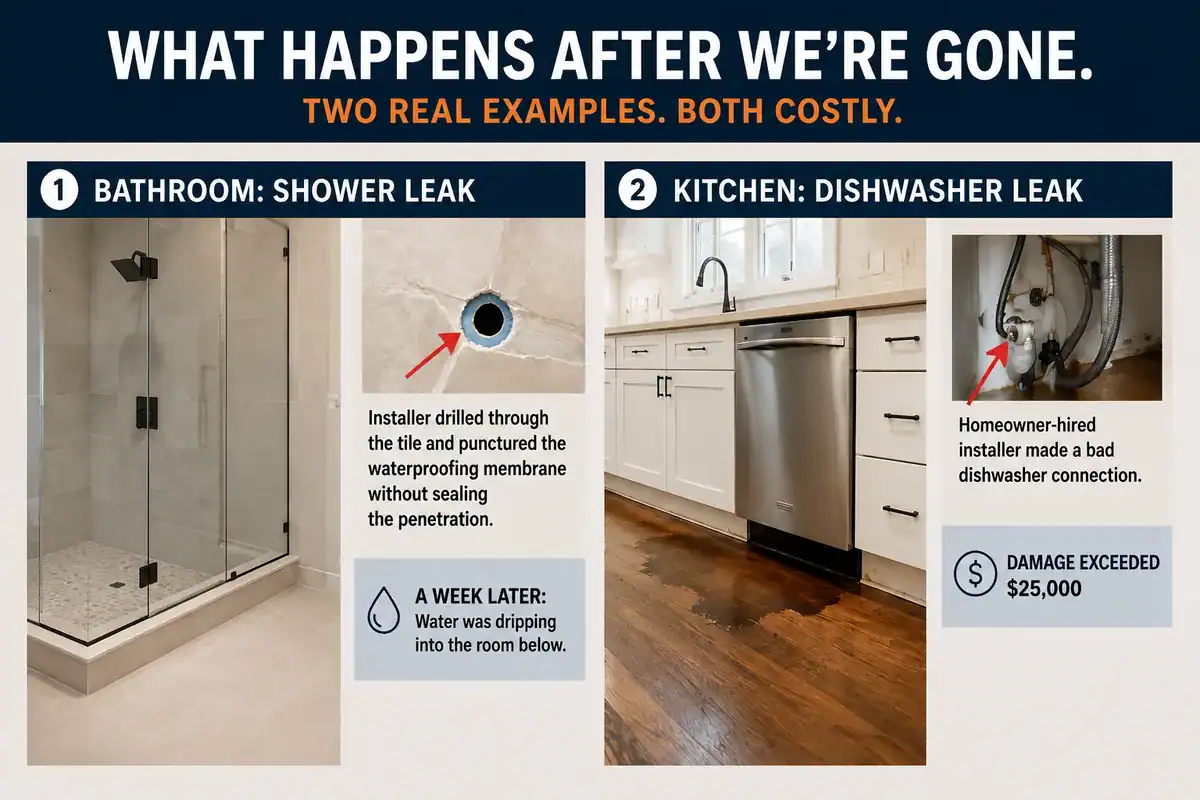
Both happened after we finished and passed final inspection, which is when homeowners feel safest bringing in an outside person for one small task.
The first was a bathroom. The homeowner hired an outside glass company for the shower enclosure. A week later, water was dripping into the room below. The installer had drilled through the tile to anchor the panels and punctured the waterproofing membrane without sealing the penetration. A shower membrane is tested and inspected before tile goes on, then permanently hidden. Anyone drilling into that wall afterward is drilling blind into the one layer keeping water out of the framing.
The second was a kitchen, where a homeowner-hired appliance installer made a bad dishwasher connection and the slow leak reached the wood flooring and cabinets before anyone noticed. Damage exceeded twenty five thousand dollars, and before insurance could resolve anything we had to prove our rough plumbing was sound and the failure happened at the hookup.
Neither homeowner did anything reckless. They hired specialists for specialized tasks. What they gave up was the one company that had built the assembly and knew what was behind the surface.
How Long Is a Contractor Responsible in California?
A workmanship warranty is a promise from your builder to come back and fix something. Ours runs one year in writing. State law is separate: it sets deadlines for filing a claim, not years of free repairs.
Under Code of Civil Procedure section 337.15, a latent defect, one hidden behind finished surfaces, carries a ten year deadline. A latent defect, one hidden behind finished surfaces, carries a ten year deadline. A patent defect, one visible on reasonable inspection, carries four years under section 337.1.
Those deadlines are identical whether you hired one contractor or five. What changes is whether you can use them. To recover anything, you must prove who caused it. With one general contractor, there is one company on the permit and one contract covering the whole assembly. With five, you first have to establish which trade failed, years later, with the evidence buried and every company pointing at the one before it.
The shower membrane and the dishwasher connection were both latent. A ten year window is worth little to a homeowner who cannot say whose work failed.
One more thing homeowners misread: the twenty five thousand dollar contractor license bond is not a warranty fund and not liability insurance. It covers license law violations. Ask to see license, bond, general liability, and workers compensation certificates.
Can I Be My Own General Contractor in California?

Yes, under Business and Professions Code section 7044. The work site must be your principal residence occupied for the twelve months before completion, the work must be done before you sell, and you cannot use the exemption on more than two structures in any three year period.
What changes the moment you sign that permit application is spelled out in CSLB’s Owner-Builders Beware guide. You assume full responsibility for all phases of the project and its integrity. You may be treated as an employer if you hire unlicensed people. You own scheduling, permits, inspections, and correcting anything that fails. And you are responsible for making sure every worker and supplier gets paid.
That last one is the one that hurts. If a subcontractor you hired brings a helper and does not pay him, the lien attaches to your house, not to that subcontractor’s business.
Two more points from the same guidance. Anyone contracting for work valued at one thousand dollars or more must hold a CSLB license, and any project requiring a permit requires a licensed contractor. And the two structure limit disappears entirely if you contract with a licensed General Building B contractor instead.
What Managing Multiple Contractors Actually Takes
The sequence is unforgiving. You cannot have the plumber set the kitchen sink until the countertop is installed. If your fabricator goes on vacation for three weeks, every trade behind him moves, and each has other customers filling that slot. You cannot pass building inspection until plumbing and electrical have passed.
Even jobs homeowners assume are simple are not. A garage conversion looks like four walls and a floor until you count what it takes: structural work at the old door opening, foundation or slab detail, insulation and envelope, electrical, plumbing, mechanical, egress, and a permit path with its own rules.
Then there is priority. To a plumber, your single task is a side job. You will not get the weekend slot. A general contractor who books that plumber all year will. You are buying his schedule, not just his labor.
Should I Hire My Own Architect or Use a Design-Build Contractor?

We have seen plans with wrong measurements. We have seen an engineer miscalculate existing grade, which meant excavating to twice the depth and pouring twice the concrete the drawings called for.
When the design team sits inside our contract, their mistake becomes our problem, and when it is a clear design error on our side of the line, we frequently absorb the difference. When the homeowner hired the architect directly, the same mistake becomes a change order the homeowner pays for, plus a dispute over whose fault it was, plus the delay of getting a separate professional to revise and restamp.
Two traps we see constantly. First, a homeowner hires an interior designer, learns the designer cannot produce permit-ready drawings, so an architect gets added. Then the designer moves a wall, it turns out to be structural, and an engineer gets added. Three professionals to do what one team would have done. Second, an architect who draws beautifully but does not handle permit submittal. The homeowner assumes whoever drew the plans will walk them through the building department, nobody owns that step, and the project sits.
There is also the availability problem. An architect running eight projects is not ignoring you, he is prioritizing, and a homeowner with one project is rarely at the top of that list. When the same delay happens inside a design-build contract, it is our schedule slipping, not yours, and we are the ones who have to solve it.
The most expensive version: a homeowner spends heavily on a complete permit set with engineering and Title 24, takes it out to bid, and finds the project cannot be built anywhere near their budget. The design money is gone.
When design and construction sit under one roof, budget stays in the room while the thing is being drawn. That includes early decisions that quietly set the cost of everything downstream, like whether to keep or change a kitchen layout, which is a design question and a plumbing, electrical, and structural question at the same time.
What To Ask Before You Hire
Once you decide to hire one contractor or multiple, make sure the single point of accountability you think you are buying actually exists. Almost every general contractor uses subcontractors, and that is normal. What matters is whether the same people come back project after project. Ours work with us exclusively, which is different from a company assembling a new crew of strangers on every job.
Ask these:
- Who holds the permit, and whose license number is on it?
- Is the design work inside your contract, or am I contracting the architect and engineer separately?
- If the engineer’s drawing turns out to be wrong mid-build, who pays for the fix?
- Do you use the same subcontractors project after project, or bid each trade out fresh?
- Who is my single point of contact, and does that person stay the same through final sign-off?
- If two of your trades disagree about who caused a problem, who decides?
- Will you provide one warranty covering the entire scope, or separate warranties by trade?
- Can I see your license, bond, general liability, and workers compensation certificates?
Answers that should concern you: any version of “you will need to coordinate that with them directly,” a warranty that stops at the boundary of one trade, or hesitation about who is responsible when something inside a wall fails three years from now.
Then get it in writing. The contractor agreement is where single point accountability either exists or does not.
Frequently Asked Questions
Is it cheaper to hire multiple contractors instead of one general contractor?
On single-trade work, yes, and meaningfully so. A roof, interior painting, flooring, pavers, or a window replacement involves one licensed specialist, and nothing gets buried behind another trade’s work, so hiring directly saves you a general contractor’s coordination cost. On multi-trade projects the savings shrink while the risk grows, because you are absorbing the scheduling and, more importantly, the burden of proving whose work failed when something goes wrong behind a finished wall. For a sense of what actually drives the number on a larger project, I’ve written a full breakdown of what a home addition costs.
Can I hire a general contractor and still bring in my own installer for one item?
You can, and homeowners do it constantly, usually after final inspection when the project feels finished. Just understand what you are taking on. The two most expensive failures we have seen both came from outside installers working on completed projects: a shower enclosure drilled through a tested waterproofing membrane, and a dishwasher hookup that leaked into flooring and cabinets. Anyone drilling into a finished wall is working blind on layers they did not build. If you do bring someone in, tell your contractor first so he can tell them what is behind the surface.
Who pulls the permit if I hire several contractors separately?
Whoever’s license is on the permit is the one the building department holds responsible for that scope, which means split projects often have several permits and several responsible parties, or an owner-builder permit in your own name. That last one puts the entire project’s integrity on you. Before you sign anything, ask the direct question: who holds the permit, and whose license number appears on it?
What is the difference between a general contractor and a design-build contractor?
A general contractor manages construction: he holds the permit, hires and sequences the trades, and delivers the finished work, but the plans typically arrive from an architect you hired separately. A design-build contractor carries the design and the construction under one contract, so the architect, engineer, and build team answer to the same company. The practical difference shows up when a drawing turns out to be wrong. In design-build, that error is the contractor’s problem to solve. When you hired the architect yourself, it becomes a change order you pay for, plus a dispute about whose fault it was.
Hire One Contractor or Multiple: Our Bottom Line

The question of whether to hire one contractor or multiple has a clean answer on one-trade work: hire separately. A roof replacement, interior painting, flooring, pavers, window replacement, an electrical panel upgrade. Nothing gets buried behind another trade’s work. Manage it yourself and keep the difference.
Hire one general contractor once trades have to interlock. A kitchen. A bathroom. A home addition, which touches soil, concrete, structure, envelope, and every system in the house. A second story. A whole house remodel. If you can do it design-build, do that, because then the plans, the budget, the permits, and the construction all sit with one company.
The reason is not convenience. Failures on those projects are the expensive kind and the hard kind to attribute. Foundation movement. Water intrusion behind finished surfaces. The money you save by splitting the scope is real but small. The money you can lose standing between four companies who each have a reason it was not them is not.
Talk To Us About Your Project
Taragano Design and Build is a licensed design-build general contractor, CSLB #1143420, based in Concord and serving Contra Costa, Alameda, Marin, and San Francisco Counties. We handle design, permitting, and construction under one contract, with one point of contact from first meeting to final sign-off, and a written one-year workmanship warranty on every project.
Want more of our remodeling guides in your Google results? Add us as a preferred source.
If you are weighing whether to split your project or keep it under one roof, tell us about it. We will walk the property with you and say honestly which one it calls for, including when the answer is that you do not need us. Call or text (925) 388-6353.
